October 30, 2015
One thinks of Hawthorne’s dictum about a book that takes the name of “Romance.” The definition of his day (please don’t think of modern-day bodice-busters) held that a Romance could play faster and looser with facts and with fictional effects than could the more demanding Novel, in which characters and events would have to conform to a more exacting standard. At the outset of The Little Paris Bookshop author Nina George introduces us to Jean Perdu (yes, John Lost). He has grieved for the last twenty years that the love of his life has left him.
"The Little Paris Bookshop" by Nina George
One thinks of Hawthorne’s dictum about a book that takes the name of “Romance.” The definition of his day (please don’t think of modern-day bodice-busters) held that a Romance could play faster and looser with facts and with fictional effects than could the more demanding Novel, in which characters and events would have to conform to a more exacting standard. At the outset of The Little Paris Bookshop author Nina George introduces us to Jean Perdu (yes, John Lost). He has grieved for the last twenty years that the love of his life has left him.
October 27, 2015
It appears this soul-sucking story had more legs and arms and disposable bodies than David Mitchell could get rid of in The Bone Clocks. This piece comes to us as the mantissa to Mitchell’s acclaimed novel published earlier this year. It’s come out just in time for Halloween, and it’s yet another highly professional set of pyrotechnics.
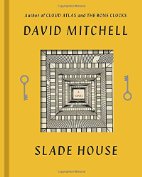
"Slade House" by David Mitchell
It appears this soul-sucking story had more legs and arms and disposable bodies than David Mitchell could get rid of in The Bone Clocks. This piece comes to us as the mantissa to Mitchell’s acclaimed novel published earlier this year. It’s come out just in time for Halloween, and it’s yet another highly professional set of pyrotechnics.
The author revisits Dr Marinus from Bone Clocks, and this time she carries out her vigilante justice against the Grayer twins, who have lived for 120 years or so … These are spooky tales with spooky effects, always carried off with assurance to spare, but I begin to wonder if Mr. Mitchell is approaching something a little deeper, about our fear of death and longing for immortality. But these companion-pieces seem too dependent on fun special effects and thrilling plot twists to try to pin anything more on them. He has always sailed very close to a current of fairness and moral behavior - see Cloud Atlas and The Thousand Autumns of Jacob de Zoet - and this pint-and-half pint of stories has the same slant.
I liked Slade House. Its closeups of characters before they’re dispatched have great verisimilitude to lives lived and emotions suffered, and the spooky effects are pulled off well. This book does feature a badass hero giving the normal comeuppance to a couple of dirtbags; the whole amounts to an exercise in waiting for this payoff. I expect Mr. Mitchell’s next effort will be on new topics, with new characters (well, maybe not all new), and different metaphysics.
October 20, 2015
"Daughter of Fortune" by Isabel Allende
Translated from the Spanish by Margaret Sayers Peden
In Daughter of Fortune Isabel Allende has crafted an epic novel of change. Many, if not most, novels feature change in their characters, but in Daughter everything changes: the main characters, the principal mode of oceangoing transportation, the United States, San Francisco, science, the press - you name it. This full, diverting novel is a paroxysm of change.
And where better to set such fiction than in Gold Rush California, a setting and metaphor for wrenching alteration if there ever was one? The prime and preeminent change occurs in fifteen year-old Eliza Summers in Valparaiso, a small, stultifying port on the Chilean coast. The year is 1847, and Eliza has just been stunned into rapture by the existence of Joaquin, her uncle’s employee, when he supervises delivery of goods to her home. This captivated glance evolves into a clandestine affair and Eliza ends up stowed away on a sailing ship - to the Gold Rush in California - as she chases after her errant lover. It nearly costs her her life.
Ms. Allende has skillfully put together a highly enjoyable epic of historical California. It’s a pastiche in which many of the epoch’s stock characters make an appearance: the heavyset madam with the heart of gold; the upstanding Quaker blacksmith who falls for a “soiled dove”; the yellow press journalist who deals more in fiction than fact. But the pastiche forms a mere backdrop for the drama unfolding in the lives of the two highly sympathetic main characters, Eliza and her friend, Tao Chi’en. That, and the human face she effectively places on the legendary Gold Rush. In Daughter of Fortune the racism, genocide, greed run amok, frontier “justice,” excessive and grasping paranoia, all get a full treatment. Then, the inexorable change to more reliable wealth - mercantilism, the professions, construction, and the sometimes deceiving trappings of civilization find their way into this nuanced and encyclopedic work.
Extra praise belongs to Ms. Allende’s conclusion. She sets every necessary trend and direction into place, and simply lets us imagine it. This is lovely, sweeping, and balanced - a unique and highly recommended combination.
October 03, 2015
"The Souls of Black Folk" by W.E.B. Du Bois
Given its theme and aims, The Souls of Black Folk has the potential to polarize its readership. There are those who would pooh pooh its weight and relevancy, but for me Du Bois propounds his theses with honesty and just the right level of plaintiveness to convey his message quite effectively. It is just these virtues that have made this important book part of the academic and social canon of the 20th and 21st Centuries.
And this is no dry academic tome. Du Bois mixes personal anecdote with his social scientist’s discerning eye to produce a very informative history of Negroes in America, slave and free, and a heartfelt polemic for equality. Du Bois’s language has a formal stateliness to it which never flags. He remains uniformly honest about the sometimes self-inflicted problems of blacks in America, but is convincing about the source of the problems, and the ways in which blunders and maliciousness in the wake of Emancipation have exacerbated them.
This book surprised me with its highly personal combination of careful research and homespun look at social trends. The personal also encompasses Du Bois’s own life: we encounter him as a young teacher and parent, as a highly respected educator, and as an early appreciator of that singular contribution of African Americans - their music. As literary output, this piece deserves its eminent status in American social letters. It deals directly and honestly with racial prejudice, serves as a central and important source on the history of race relations in America, and exhorts its audience to consider the state of relations and how it can be cured. It’s necessary reading for any person interested in the subject in America.
September 26, 2015
The highly talented and National Book Award-winning author Colum McCann offers four shorter pieces in Thirteen Ways of Looking; they are varied and vivid, captivating and thought-provoking. Its memorable characters include a retired judge trying to fathom the self-absorbed boor who is his son; a lonely Marine stuck on a mountainside in Afghanistan on New Year’s Eve; a single mother of an adopted son who neither hears nor speaks; and an aged nun jolted into reliving days of torture from decades before.
“Treaty” is a work of understated brilliance. An aged nun is shocked into a downward spiral when she unexpectedly sees her onetime tormentor in the news on TV - he is the South American man who imprisoned and tortured her decades before. For an old woman on the downward slope to her life’s end, she finds an extraordinary strength and resourcefulness and confronts this slime from her past, traveling from Long Island to London, and hunting her quarry like an accomplished detective. The scene of their confrontation, a few remarkable and quiet minutes in a coffee shop on a London street corner, is stunning - we cheer for our tired but triumphant nun, and even further for her understanding with the shop owner as she gets ready to leave.
"Thirteen Ways of Looking" by Colum McCann
The highly talented and National Book Award-winning author Colum McCann offers four shorter pieces in Thirteen Ways of Looking; they are varied and vivid, captivating and thought-provoking. Its memorable characters include a retired judge trying to fathom the self-absorbed boor who is his son; a lonely Marine stuck on a mountainside in Afghanistan on New Year’s Eve; a single mother of an adopted son who neither hears nor speaks; and an aged nun jolted into reliving days of torture from decades before.
These stories bear the McCann stamp: their characters’ inner voyages convince and compel. We encounter events - either violent, pathetic, or simply recognizably human - which push lives into new directions. Characters frequently don’t welcome these directions, as occurs to many of us in life, but in McCann’s hands we feel their inevitability and sympathize with the anguish they produce.
In the title piece, we join in an elderly retired judge’s consciousness as he wakes one winter morning in his Manhattan apartment. His mind rambles in and out of different compartments: pop culture, with its song lyrics and puns; the various indignities of dotage, particularly the horror of being put in a diaper while asleep; the charms of his Caribbean live-in nurse; the ache of missing his dearly departed wife. His luncheon at a local restaurant with his son, a funds trader at a large downtown firm, taints him unfortunately with a stain from his son’s sordid life, with catastrophic results. Besides the utterly convincing stream of the old judge’s thoughts, this story also features excellent shifts in point of view, as we meet homicide detectives while they review video footage.
A dark solitude and linearity distinguishes “What Time is it Now, Where You Are?” A woman in the Marine Corps holds a lonely New Year's Eve vigil on a freezing mountain in Afghanistan, after encouraging the rest of her platoon celebrate at the base without her. She counts down to the moment when she will put her satellite call to her partner back in South Carolina. This piece is almost a metafiction. McCann asks us to imagine a writer who, working against a deadline, tries to piece together a holiday story. He writes about writing the story, and gradually, this vivid and chilling scene forms. The voice in which he composes, the way in which he places himself inside the narrative, is unlike anything I have seen. That, and the tenuous stretched-out distances of the piece - calls to far-off continents, the possibility of a sniper’s laser light and bullet finding her in the utter darkness - make this story an awe-inspiring, multilayered treat.
In “Sh’Khol” a single mother spends a panicked few days while the authorities search in their plodding, inexorable way for her missing adopted son. The story serves to bring out her feelings of inadequacy, about which her ex-husband helps her not at all. The young man is ultimately the focus, as his experiences become clear to Mom after his return. Youthful dismay at the maturing process becomes especially pronounced in one who can neither hear nor speak.
“Treaty” is a work of understated brilliance. An aged nun is shocked into a downward spiral when she unexpectedly sees her onetime tormentor in the news on TV - he is the South American man who imprisoned and tortured her decades before. For an old woman on the downward slope to her life’s end, she finds an extraordinary strength and resourcefulness and confronts this slime from her past, traveling from Long Island to London, and hunting her quarry like an accomplished detective. The scene of their confrontation, a few remarkable and quiet minutes in a coffee shop on a London street corner, is stunning - we cheer for our tired but triumphant nun, and even further for her understanding with the shop owner as she gets ready to leave.
These stories reinforce my opinion of Mr. McCann. Since 2009’s Let the Great World Spin, I’ve thought him one of the very best plying his trade today. By all means, pick up and savor these stories.
September 19, 2015
"The Bone Clocks" by David Mitchell
We meet lovely Holly Sykes in 1984 as a rebellious 15 year-old in Gravesend, a town in Kent fronting on the Thames. By novel’s end, she’s in her 70s, living in Ireland, with every reason in the world to be frantic and worried. The Bone Clocks centers on Holly and her adventure among some exceedingly unusual humans - humans who travel in time, have psychic and psycho-kinetic powers, and who cheat death for centuries.
Holly provides the focus, but author David Mitchell provides the pyrotechnics. He populates his novel with two opposing camps of warriors. One side “decants” human souls to renew their own life forces, while the other side tries to save people from this ugly fate. Holly is a marginal soldier in this war, because she was psychic as a child, and because one of the villains once loved her. She plays a critical role in the climactic battle, using a comically old-fashioned weapon in a psycho-battle royal among super-beings. You have to read it.
This author plays so stylishly, and fills our consciousness with such outlandish issues, that he continues to be a favorite. He does a very thorough job of setting up the conflict that we know is coming, and Holly’s everywoman role provides the reader a portal through which to witness this startling and vivid fight. Because of all this, I’m disappointed with the post-battle sequence, where Holly’s and her family’s history is wrapped up and we learn what happened to her ancient ally (but not her onetime lover). It’s set in a post-apocalyptic dystopia in the 2040s and Holly’s struggles see their final battle. Mitchell uses this framework not only to necessitate the book’s final conflict, but also, it seems to me, to wag his finger at the naughty modern world for its profligate and polluting ways.
This detracts from the book’s other delights. It feels tacked-on, a disjointed attempt to wrap up the story’s loose ends. As much as I agree with his sentiments, this seems a heavy-handed and unworthy try. The book is overlong as well - it could have done without the section on the lonely writer’s life altogether.
I do recommend this book, however, but with something less than my usual ardency where David Mitchell is concerned. I recommend it for its flight of fancy, which Mitchell handles at least as well anybody out there. His fantasy concepts and executions are second to none I have encountered. This book, however, could have big chunks excised and be much better.
September 05, 2015
Two old friends fall spectacularly out in Amsterdam; it forms the plot of this Booker Prize-winning novel, and it makes an intriguing read, even if getting its lessons takes something out of you.
"Amsterdam" by Ian McEwan
Two old friends fall spectacularly out in Amsterdam; it forms the plot of this Booker Prize-winning novel, and it makes an intriguing read, even if getting its lessons takes something out of you.
Clive is a renowned composer working desperately to meet a deadline on a commissioned piece. Vernon edits a well-respected daily newspaper, on the verge of publishing a stunning front-page piece to ruin a prominent national politician. Author Ian McEwan achieves his best effects when describing the settings, processes, and personal anxieties of these two men on the eve of what could be the crowning achievements of their respective careers. Instead, they reach loggerheads on some matters of principle, and each falls back on petty jealousy, egomania, and paranoia, to his emphatic downfall.
I’ve seen the book described as “darkly comic,” and while I agree, I would stress that Mr. McEwan intends to steep his readers not only in the unpleasant realities of a relationship gone bad, but also in the ghastly reality of modern society’s culture of self-absorption and moral turpitude. It’s easy to convince oneself that the book received the Booker based on this fact alone. It’s a good reason.
As solid a job as this is, I found the reading a little disturbing - too close to modern societal sickness for comfort. That is exactly what this book is about, and its message hits home extremely effectively.
August 30, 2015
Well-paced and plotted with admirably high improbability, A Curious Beginning introduces the dynamic duo of Miss Veronica Speedwell and Mr. Revelstoke Templeton-Vane. The story is set in Victorian London and our heroes face a plot that not only threatens their lives, but could also topple the most powerful monarchy on Earth. The pair struggle with trust issues early on, but form a formidable team which promises many delights in the books to come.
"A Curious Beginning" by Deanna Raybourn
Well-paced and plotted with admirably high improbability, A Curious Beginning introduces the dynamic duo of Miss Veronica Speedwell and Mr. Revelstoke Templeton-Vane. The story is set in Victorian London and our heroes face a plot that not only threatens their lives, but could also topple the most powerful monarchy on Earth. The pair struggle with trust issues early on, but form a formidable team which promises many delights in the books to come.
And readers will avidly receive and follow the exploits of Ms. Raybourn’s plucky, determined hero and her partner in the books to come, I’m sure of it. The author has expertly introduced enough issues between the two to keep readers’ energies focused for many entries in this new series.
As they try to learn each others’ truths, the highly appealing pair find themselves pawns in high-level machinations against the British Imperial throne. These schemes focus on two hot buttons for Queen Victoria: the Irish Home Rule question, and the identity of her successor to the throne. These issues bring a grand load of weight and urgency to the proceedings - far be it from my disbelief not to be willingly suspended. The mystery, the heroes’ intrepid handling of all threats to life, limb, and Empire, and the supporting characters’ motives and actions, are all very strong points in the book’s favor. I feel comfortable recommending it based on these.
But I feel I can’t do justice to the two heroes. In an introductory story, they match wits and tempers, they verbally spar, eventually they work as a cohesive unit - they are memorably introduced here. They treat each other in a highhanded manner, as befits a staunch Victorian man and a willful woman equal to his every objection. However, these scenes dominate the bulk of the book, and I found myself tiring of all the personal conflict. This may have been the author’s intent. After all, their lives are in jeopardy and at stake throughout the whole book. However, there’s a slight awkwardness in the presentation - certain of the scenes proceeded with an emotional herky jerkiness that could have been handled more smoothly.
Overall, however, I fully expect these two vivid characters will settle on investigative strategies and tactics for escaping the close scrapes and tight spaces that will inevitably lie in the path ahead. Ms. Raybourn has introduced a new series, and in particular, two new protagonists, in this exciting and assured effort. Climb aboard and buckle your seatbelt - this promises to be one stylish ride!
August 25, 2015
Plain and simple, touching and hopeful, Kitchen has philosophical asides sprinkled throughout that give it depth and charm. This charm emanates from Mikage, the young woman who loses her beloved grandmother, and from Yuichi, whose mother passes away a few months later.
"Kitchen" by Banana Yoshimoto
Translated from the Japanese by Megan Backus
Plain and simple, touching and hopeful, Kitchen has philosophical asides sprinkled throughout that give it depth and charm. This charm emanates from Mikage, the young woman who loses her beloved grandmother, and from Yuichi, whose mother passes away a few months later.
These philosophical asides have the virtue of being spoken very plainly and grow out of the normal thoughts and emotions of our heroine, Mikage. So unadorned and succinct are they that they frequently achieve a poetry reminiscent of Basho, or other masters of haiku. They even at times approach a Zen state in propounding newly discovered, or newly obvious, truths as Mikage encounters them.
Mikage is a university student in Tokyo when her grandmother’s death unmoors her. She misses her classes, withdraws, and sleeps great clumps of her life away. When invited by Yuichi and his radiant mother Eriko to stay at their apartment indefinitely, her life turns around, and her relationship with Yuichi takes on a complicated, so-many-things-left-unsaid quality.
Ms. Yoshimoto resolves this relationship satisfactorily, but Mikage’s growth in maturity and wisdom constitutes the true treat in Kitchen. This is a brief, uncomplicated read, but its marbling of a young, appealing woman’s reflections and yearnings commend it to the discerning reader. Recommended!
August 15, 2015