-->
no

"The Quick" by Lauren Owen

No comments


There is a rather chic monster populating – or maybe overpopulating – popular culture these days. It sucks the blood of unfortunate victims, sometimes killing, and sometimes turning the victim into another monster like itself. Lauren Owen has produced The Quick and released it into this popular culture, and taken a very different tack with her subject.

This novel presents a handful of lives affected by the unwilling conversion of a Victorian London man into one of these monsters. It deals with the pain and confusion of being thus transformed, and with the guilt, fear, and hopelessness of those he once loved. If you want some hope from these ghastly and gruesome events, you won’t find it here. The man transformed – we don’t encounter the ‘v-word’ before we’re past the first-quarter mark of the book – cannot help what he has become, and so cannot help the famished and murderous way he feels. And so his devoted sister tries to help, ultimately to no avail.

That is the story. The whole thing is fanciful, obviously, and atmospheric to a fault. It is simply a dark book from beginning to end: many scenes are nighttime scenes because of vampires’ hatred of the sun and light; even daytime scenes are smudged with 19th-century London’s famous fog. But more than that, this story completely lacks hope. There are two classes of vampire in London at the time: one is an elite club of wealthy and
powerful gentlemen, who voluntarily gave up living for the rewards of the un-dead life. The other are famous London street urchins, poor, vicious, lawless. And this is actually one of the interesting points here – there is class division and strife even among inhuman monsters.

Ultimately I can’t see my way to recommending this book. Its descriptions of the psychological and physiological changes occurring in newly-turned vampires are interesting – a different take on some popular fancies, but really that is not enough to save this book.
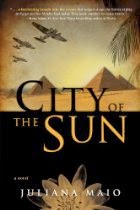
"City of the Sun" by Juliana Maio

No comments


Author Juliana Maio presents us in City of the Sun with a gratifying bit of what Alan Furst calls “near history.” With vivid, urgent scenes of World War II Cairo, Ms. Maio portrays the struggle of the Jews in that city in the early days of the war. She lays over this a reasonably effective romance, which serves as the centerpiece to this novel, and the whole works rather well.

Maya Blumenthal, her father, and her brother Erik have fled Paris in 1941, having first flown from Nazi Germany before that. Cairo is an unusual refuge for displaced Jews at the time, many of whom at this point wind up in Britain. But the Blumenthals have relations in Cairo, and it is at least a good temporary shelter. But Erik isn’t just another Jewish refugee. He’s an advanced physicist whose latest paper has drawn the attention of the Americans and the Germans. Both want his expertise for their weapons programs. Enter Mickey Connolly, a brash American journalist who in the course of things is recruited by “Wild Bill” Donovan into espionage, specifically the “acquisition” of young Erik Blumenthal.

Ms. Maio’s makes it her mission here to educate her readers about wartime Cairo and its pivotal role in the changed and changing Middle East. This she does through conversations of people in the know and official pronouncements and events, and she does it superbly. It was a great education for me – I had never been exposed to the history before, in spite of my own father’s service in the Army Air Corps at the time. She spices up the telling with two sure bets, an espionage thriller and a romance. And, surprisingly, she handles both with assurance, delivering believability and a couple of really magic scenes.

This is a highly diverting and educating piece, and I recommend it. It’s solid history delivered with  multi-faceted appeal.

"The Orphan Master's Son" by Adam Johnson

No comments


Try to inhabit the no-man’s-land of North Korea in Adam Johnson’s The Orphan Master’s Son without feeling an eerie gray mood take you over. Use it as an aid to perspective, when you consider the modern ills in your own home country. For Mr. Johnson has distilled the pain and degradation inflicted on North Koreans into his protagonist, an orphan who is not an orphan.

And any consideration of this Pulitzer Prize-winning book must start and end with the main character – a man who cannot even claim his own name. Mr. Johnson shows that orphans must take their names from one of the “heroes of the revolution.” As a young boy our protagonist receives the name of a state hero who committed suicide rather than let any wartime suspicion fall on him. Even though he really does have a father, he is treated as an orphan – despised and mistreated, and given all the worst, most dangerous jobs. He thus captures the whole of North Korean society.

The events of this novel illuminate the perverse and paranoid customs, particularly the caprices of the so-called criminal justice system, of this isolated country. The first two thirds feel episodic, until fate draws our hero into the life of a celebrity actress, a favorite of the dictator’s, and the story gains some clarity and momentum. The man comes to love her, and works assiduously for her safety and security. Doing that comes at tremendous cost, as the hero knows full well. Anyone wanting to escape North Korea must leave no family or
friends or associates or acquaintances behind for the state to punish, and this complicates things for everyone.

The author further complicates things by telling the last part of his story in a fluid chronology – we bounce back and forth between two periods, one after the hero is arrested the final time and one before. This strategy creates a tension in the reader – it makes her anxious to learn the fates of the main characters, and Mr. Johnson conditions us not to expect the best.

While this book has much to recommend it, it was a tough slog for me, because of the subject matter and setting. It’s a deserving Pulitzer winner, for two features: Mr. Johnson’s daring and unorthodox handling of his plot, and for his creation of a splendid, memorable hero, in whom he instills a suffering country’s best characteristics and best hopes.

"Snow in May" by Kseniya Melnik

No comments


Snow in May captures in its title the exotic nature of this engaging short story collection by new writer Kseniya Melnik. Ms. Melnik, having lived some of her life in Alaska, and now residing in El Paso, sets her stories in her native Magadan, a Russian city on the Sea of Okhotsk, the section of the Pacific Ocean that borders northeastern Russia. Many of these stories have the flavor of memoir, since they give insight into the deep chasm between Russian folk culture and modern American interest in money, fads, and oneself.

As often happens with recent story collections, one can categorize them by subject matter. Many of the stories here deal with Soviet era economics and politics, with its long queues for everything from shows to fruit to bus rides, and the omnipresent secret police with its network of informants. Other stories deal very frankly with the baffling and intimidating encounters when leaving Russia’s far east for America. These stories give the reader new understanding of these transitions and new reminders of Russian character – in these functions, these tales excel.

The collection’s opening piece, Love, Italian Style, or in Line for Bananas, a married Russian woman visiting Moscow on business must decide between a tempting proposition from a handsome Italian footballer and the rare opportunity get in line and buy bananas. This story is funny, endearing, balanced, and wise to the world. It’s set in 1975 which adds Soviet bloc weight to the bifurcating choice, but could really be set anywhere in any era. The gem of these stories is The Uncatchable Avengers, whose grade-school protagonist flubs several takes for TV, when trying to play a short Tchaikovsky piece for piano he knows well. He’s considered gifted, but can’t keep his focus, because he keeps thinking of the two-man gang he and his best friend had formed just the day before, the Uncatchable Avengers, based on a TV show. He dreams of finding clues to murders, and fighting gangs of thugs, and so he can’t play his simple piece. The drastic tactic his piano teacher finally employs to get him focused
leads to his flawless playing; a jubilant 9-year-old running outside afterward in the miraculous event of a May snowfall; and a highly gratified, smiling reader, smarting with the sweet sting delivered by effective, reverberant fiction.

Other stories record the divide between the East and West, between husband and wife, and between generations. Our author highlights characters faced with very human issues, and treats them with respect and compassion. This writer has gifts, and a unique background, and I anticipate liking whatever she produces in the future.

"Ruby" by Cynthia Bond

No comments


Stuck between various versions of hell on earth, the eponymous Ruby of Cynthia Bond’s novel is victimized shockingly early in life by the adult men and women of her world, and driven mad. Ruby the novel overflows with evil voodoo spirits, and by Christian women who compete with each other in self-righteousness.

In a backwater colored township (the author’s description) in East Texas, a beleaguering series of vicious men and women subject Ruby to every depredation: she’s sold into prostitution incredibly young, taught to expect that rape and abuse are her just due. This perverts her into something with no sense of self, other than an automaton who divorces her emotions from her life. Small wonder. It’s also no surprise that Ruby develops a schizophrenic belief in ghost children – dozens, maybe hundreds of them, which apparently correspond to injuries and disappointments in her hellish life.

The author makes the ongoing point about ordinary men being potential rapists when caught under certain influences, and in one pivotal scene puts a crowd of them under a kind of possessive black-magic trance, but most of the men
who take advantage of and abuse Ruby are clear-eyed enough. Ms. Bond introduces Ephram, the only man in the world who wishes Ruby well, and the Christians and evil haints do battle for his and Ruby’s souls.

As an emblem and reminder of what horrid lives victimized women and boys lead, this book succeeds with a somewhat unartful repetition, with some scenes quite effective. As a study in human emotion and a traumatized person’s attempt to cope with a nightmare existence, this story feels arbitrary and forced together, with responses not fully warranted by events, even supernatural events.

Not recommended.